

How to Plan a Calm Home Clearout Project Without the Overwhelm
You know that heavy, drained feeling when you look around your home and don’t even know where to start. Every surface holds a little bit of guilt. Closets feel like they bite back when you open them. Your brain says, “Fix this,” and your body says, “Not today.”
Living in clutter quietly eats at your energy. It steals time, too, because you’re always moving piles, searching for things, or feeling guilty about what you haven’t done. Decluttering through a big home clearout project sounds like the answer, but the size of it can freeze you in place.
You’re not lazy. You’re overwhelmed.

And if you’re clearing out a loved one’s home after a loss, that weight runs even deeper. Suddenly the piles are memories, stories, and reminders of someone you’re grieving. That makes the whole project heavier, slower, and far more emotional than a normal declutter.
This guide shows you how to plan a clear, simple project that feels calm and doable. Whether you’re clearing your own home or sorting through a parent’s or grandparent’s home after they’ve passed, You’ll learn how to break the big job into small steps, make decisions faster, protect your energy, and actually finish. Even with a busy life and a tired brain.
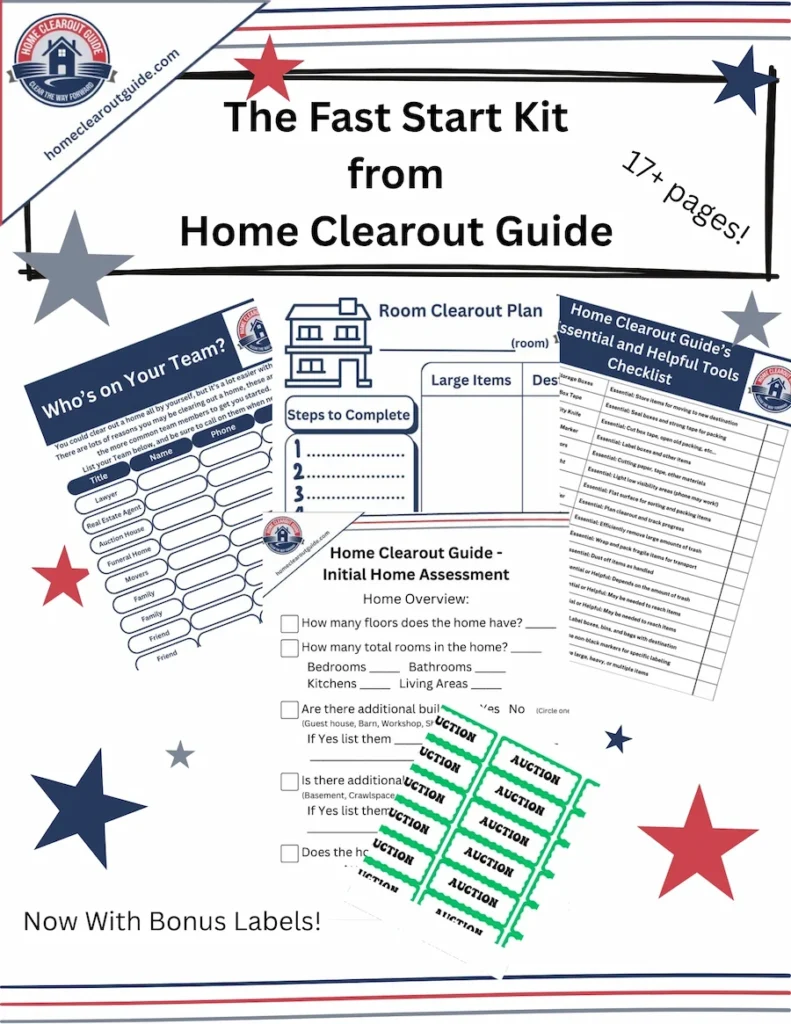
Want a smoother start? Grab the free Home Clearout Guide Fast Start Kit.
It includes the Initial Home Assessment workbook, a tools checklist, a team contact sheet, room-by-room planning pages, and printable labels. All the starter tools you need to beat the chaos and begin with clarity.
Preventing Overwhelm Clearing Out a Home After a Family Member Has Passed

A full home clearout after losing a loved one is one of the hardest household tasks anyone can face. This isn't stuff to be organized. You’re facing memories, grief, and sudden responsibility, all while trying to honor someone’s life.
I’ve been through this personally with my great grandparents when I was young, my grandparents in my 30s, and recently my childhood home when my mom passed and we needed to clear it out and move my dad in with us.
Every one of those projects was emotional, overwhelming, and filled with moments that stopped me in my tracks.
Here are a few truths that make this easier to accept:
1. Your emotions are valid, and expected.
Crying, shutting down, or getting stuck is grief, not failure.
2. You don’t have to go fast.
Estate clearouts are marathons, not sprints. And decluttering your own home allows even more time to get the job done. Slow, steady progress is enough (depending on probate deadlines, moves, etc…)
3. You’re allowed to keep things for now.
If something brings comfort, keep it and decide later. Don't let indecision about 1 item slow your momentum!
4. You shouldn’t try to do the whole house at once.
Start with one small, low-emotion area to build momentum. Think small bathroom or guest room closet.
5. You need a plan, especially when emotions are high.
Without a plan, each room feels like a minefield. Each item a chance to get derailed. Feel your emotions, then peek back at your plan and take the next step.
This is exactly where the Fast Start Kit from Home Clearout Guide makes the biggest difference.
When the emotions are heavy and the decisions feel impossible, the kit gives you structure. Fill out the Initial Home Assessment workbook, the Room Clearout Planning sheets, the Team Contact sheet, and the Essential and Helpful Tools checklist. Everything you need to get off to a fast start with your clearout! And, use the printable labels to keep the process clear and grounded.
Face the Overwhelm: Why Home Clearouts Feel So Hard
Before you touch a single box, understand why feeling overwhelmed makes this so hard. Once you can name the problem, you can plan around it.
When I helped clear my grandmother’s house, I remember standing in her bedroom thinking, “We will never get through this.”
It wasn’t the stuff. It was the emotions, decisions, and pressure all hitting at once. Losing the matriarch of your family is so tough. Having to stand in decades of memories and possessions and look at them as a project to be completed is a whole other level of hard.
Clearing out your own home, whether for a declutter, a downsize, a move, or just to feel better in your space, can bring up many of the same emotions.
You may feel stuck for the same reasons.
Spot the signs you’re stuck in clutter stress
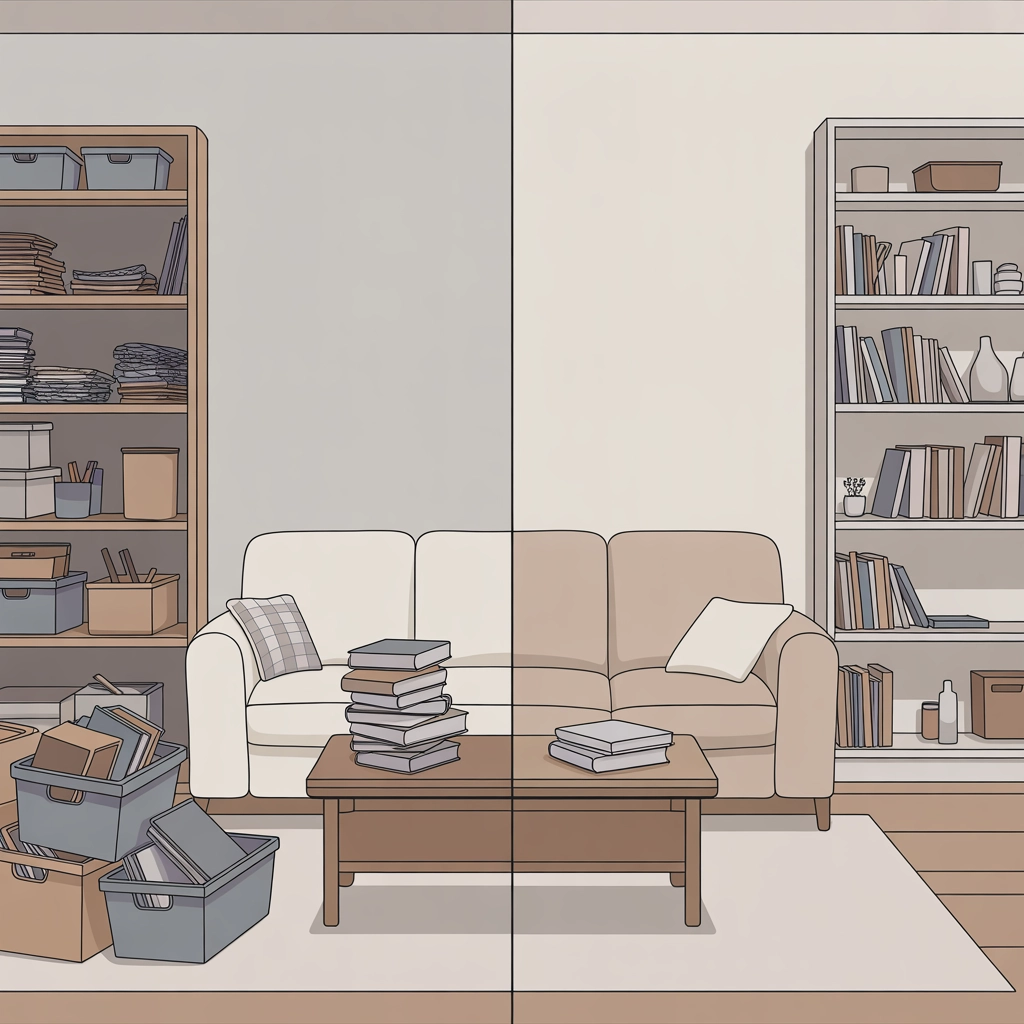
You might see yourself in these:
- You walk into a room, tense up, and walk right back out.
- You start piles, then get stuck on what happens next.
- You buy storage bins or baskets instead of deciding what stays.
- You feel guilty whenever you see certain rooms or stacks of things.
You’re overwhelmed, not broken.
Understand the hidden reasons you avoid starting
Several powerful forces work against you:
- Decision fatigue: Hundreds of choices at once = burnout.
- Emotional attachments: Items feel like memories, or people.
- Fear of regret: “I might need this someday.”
- Perfectionism: If you can’t do it perfectly, you wait.
- No clear plan: “Clear out the house” is not an actionable plan.
Once you name these, you can beat them with small steps and clearer structure.
Shift your goal from a perfect home to a calmer home, or an empty home
You don’t need a perfect, magazine-ready house.
You need a home that feels kind, calm, and easy to live in.
Maybe for now, you just need more empty space so you can think.
Start tiny. Pick simple wins that feel almost too easy, like:
- One clear surface in each room
- A clear path through the living room
- One workable spot to cook

These small wins stack up.
A clear counter makes dinner easier.
An open chair invites you to rest.
A clean patch of floor untangles your mind.
Progress creates energy. Perfection kills it.
Drop the standards no one can live up to, give yourself room to grow.
Create a Simple Home Clearout Project or Organizing Plan You Can Actually Follow
Planning comes before touching anything. Without a plan, you burn out or end up with half-finished rooms and bigger messes.
When I cleared my parents’ home, the days I had a plan felt calm. The days I winged it ended with frustration and slow, if any, progress.
You need to build a plan and save yourself those frustratingly slow days.

Decide your “why” and your deadline
Start with the real reason, the one that actually gets you off the couch.
Keep it short and blunt:
“I’m clearing this house so we can move by June.”
“I want less stress before the baby comes.”
“I have a probate deadline to meet.”
“I don’t want my kids stuck with this mess.”
When I cleared my grandmother’s house, my why was, “I want this done before the auction so nothing important to the family ends up sold because we didn't go through it first.”
That one line kept me moving when I was on the floor, buried in boxes. It got me back up when my emotions knocked be down.
Once you’ve got your why, pick a hard deadline. Not “sometime this summer,” a date.
“Garage empty by April 15.”
“Kitchen sorted before the baby shower.”
“Main floor cleared before the realtor walkthrough.”
No deadline means the house sits half-sorted for months, even years, with the same boxes drifting from room to room. It means your home clearout project stalls out.
Your why is the fuel, your deadline is the finish line. You need both to stop circling the same piles and actually clear them.
Pick one clearout goal for this season
Don’t try to fix the whole house at once.
When I cleared my parents’ place after my mom died, I thought maybe I'd tackle several rooms in one weekend. I ended up crying on the bedroom floor, buried in half-open boxes and old journals.
When your goal is too big for the time frame and emotions run high, it's easy to get off track.
Once I started pairing appropriate timelines with clear goals, the whole project finally started to move.
Pick a single, concrete target, like:
- Today pack the dining room, tomorrow clear the dining room furniture
- Clear 50% of the garage so the car fits.
- Declutter the guest room so someone can sleep there.
That “fix it all” energy feels powerful, but it burns you out fast. One sharp goal beats five fuzzy projects.
One clear goal plus a reasonable deadline means less stress, less spinning, and real, visible progress.
Break your home into zones and tiny steps
Slice each room into small, clear, micro-zones so your brain does not freeze.
When I cleared my parents' bedroom, I didn't “do the dresser.” I did:
- Top of the dresser
- Top right drawer
- Top left drawer
- Each bottom drawer, one at a time
Use the same idea anywhere in the house:
- Left side of the closet (just shirts on hangers)
- Right side of the closet floor (only shoes)
- One pantry shelf
- One kitchen drawer
- One bathroom cabinet door

Each micro-task should take about 10 to 20 minutes, start to finish.
That short burst keeps the work from feeling endless, and you still see real progress. It turns a whole chaotic kitchen into one junk drawer you can handle today, then the next small zone after a break, or even tomorrow.
Once you have momentum you may not want to wait until tomorrow!
Set a realistic clearout schedule
Clearing out my parents' home I generally had Sunday afternoons free, and that was it!
Between a full time job, kids in school, soccer and football and gymnastics and band practices, and my wife in grad school at the time, Sunday afternoons were all I had to work with.
Match your sessions to your real life:
- 30 minutes after dinner, 3 nights a week
- A 60-minute weekday session + a 90-minute weekend one
- Two 20-minute sessions on workdays
Add them to your calendar like real appointments. Treat them like part of the weekly schedule.
Gather your clearout tools before you start
Preparing is half the battle. Every home clearout project needs the proper tools. A few things that will help carry you through include:
- Trash bags (I prefer the big black stretchy ones)
- Boxes and labels
- Pallet wrap
- Cleaning wipes
- A timer
These tools remove friction so you actually start, and keep going.
They also lineup with the Tools Checklist in the Fast Start Kit.
Use the CLEAROUT Method to Sort, Decide, and Let Things Go
Now that you’ve built your plan, you need a simple system that works in any room — whether you’re decluttering your home or clearing out a loved one’s belongings after a loss. That’s where the CLEAROUT Method comes in. It’s inspired partly by the simplicity of Dana K. White’s decluttering approach, but built specifically for full-home and estate clearouts.
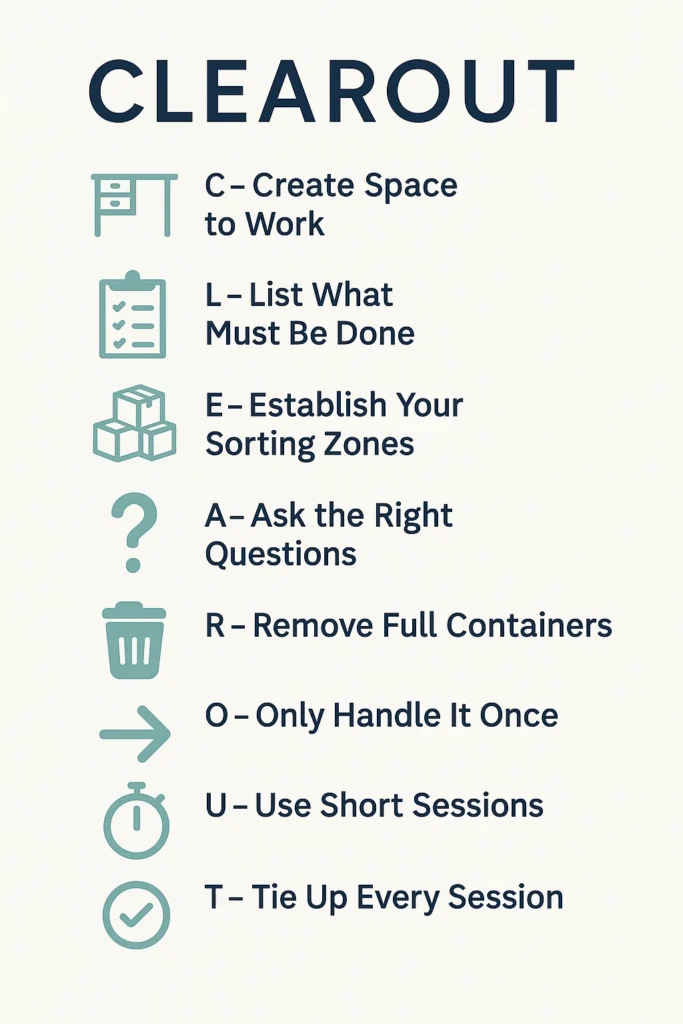
Here’s how it works:
C — Create Space to Work
Start by clearing a small, visible area so you can move freely.
Grab the obvious trash, remove anything that clearly doesn’t belong, and make a little breathing room. A small clear space calms your brain and gives you fast momentum.
L — List What Must Be Done
Use your Room Clearout Guide worksheets from the Fast Start Kit to quickly list the next steps for the room you’re working in.
A few simple notes give your session direction and prevent the “What was I doing?” spiral.
E — Establish Your Sorting Zones
Use the categories from your Fast Start Kit labels so every item has a clear destination:
- Keep
- Storage
- Sell
- Auction
- Give To ______ (for family gifts or donations)
- Trash
Set these zones up before you start so every item you touch immediately has a home.

A — Ask the Right Questions
Use simple, direct questions to guide each item to the correct zone:
Trash:
Is it broken, expired, or not in good enough shape to give to someone else?
Give To ______:
Would someone I know want this more than I do?
Is it sentimental to them?
Should I donate this to a cause or someone in need?
Storage:
Do I need this, just not often?
Am I not ready to decide on this within my timeline?
Keep:
Would I pack this and take it with me if I moved?
Is this item deeply meaningful or sentimental to me?
Sell:
Would someone realistically pay for this — and will I actually take the time to sell it?
Auction:
Should this go to an estate sale?
Does it have collectible or specialty value that an auction house could handle?
These questions keep decisions quick, honest, and guilt-free.
R — Remove Full Containers
When a box, bin, or bag is full, take it out right away.
Full containers = done containers. Get them out of the room.
O — Only Handle It Once
When you pick up an item, decide its destination and move it to the correct zone immediately.
No setting things down “for later.”
One touch, one decision, one action, that’s how the room gets clearer, faster.
U — Use Short Sessions
Protect your energy by working in short, focused bursts:
- 15 minutes
- 20 minutes
- or 30 minutes
Set a timer, work the method, stop when it rings, and reset the room.
Short sessions prevent burnout and make an overwhelming home clearout project manageable.
T — Tie Up Every Session
- Empty trash and load donations into your car
- Make a quick note about where to start next time
- Take a break — you’ve earned it
This keeps your space clear, your mind calm, and your next session easy to begin.
How to Handle Small Sentimental Items Without Losing Momentum
Photos, family videos, letters, journals, kids’ artwork… these tiny sentimental items can stop your whole clearout in its tracks. They carry memories, stories, and emotional weight, and it’s completely normal to freeze when you see them.

Here’s the key truth:
Sentimental items require a different pace than the rest of the clearout.
Use these simple, gentle habits to keep your project moving without ignoring your feelings:
1. Save small sentimental items for later rounds, or even another time
You don’t need to make emotional decisions on Day One. You may not need to make them until after the clearout. For an example, see the story of my brother's box.
Keep moving through the easier layers of the home and come back to the sentimental category when you have more clarity and momentum. OR, you can just box them up and send them to their new home or storage, and deal with them on your own time once the main clearout is complete.
2. Give them their own labeled box
Use a “Give To ______” label or write “Sentimental — Review Later” on a box.
This lets you safely set them aside without losing track of them or forcing rushed decisions.
3. Keep only the meaningful, not the duplicate
Photos, letters, and journals tend to show up in batches. Keep the ones that hold the strongest connection or memory. Let the duplicates go.
It's also easy to discard landscape pictures we don't have any context or attachment to. It it wasn't your trip to the grand canyon, there are no important peopl in the shot, and the family on that trip are not longer around, you can let those pictures go.
4. Consider digitizing when it makes sense
Scanning photos, letters, or old documents can preserve the memory without keeping every physical item. It’s not required, but it can be a helpful option when you’re short on space or need emotional distance. If you're on a tighter timeline this is probably a step for after the home clearout project is complete.
5. Share the story, not just the item
If something feels meaningful but doesn’t belong with you, pass it to the person whose memory or story it carries. This is especially powerful during estate clearouts. But DON'T take offense if they don't want the item. Everyone deserves agency over what comes into their home.
6. Give yourself permission to keep things
You’re not “doing it wrong” if you keep an item that brings comfort or connection.
You’re allowed to honor your memories and your grief.
7. Set a gentle review timeline
You don’t have to decide everything today.
Pick a time in the future, even six months from now, to sit with those sentimental items with a clearer heart and a calmer mind. Put it on the calendar!
Stay Calm and Motivated While You Clear Out Your Home
Planning and systems get you started.
Your mindset keeps you going.
Protect your energy with short, timed sessions

Set a timer for 15, 20, or 30 minutes.
Short sessions create the consistency that actually clears homes.
Get help when you need it
Bring in:
- A friend
- A family member
- A teenager to haul bags and boxes
- A professional organizer
- A junk removal service
Asking for help is smart, not weak. A little help goes a long way during a home clearout!
Celebrate small wins
Your brain needs proof this is working.
Try:
- Before/after photos
- Crossing off micro-tasks
- Texting family or a friend progress photos
Celebrate what you can see, which should be empty or organized space!
Plan how to keep clutter from creeping back
Try simple habits:
- One-in, one-out
- 10-minute nightly tidy
- Keep a donation box by the door
- Seasonal mini-clearouts
Small habits protect your hard work.
One Tiny Zone, One Short Session
Planning turns a scary decluttering project into a calm, doable one.
When you know your “why,” break your home into small zones, and use simple sorting rules, you remove most of the overwhelm before you begin.
You don’t need a perfect weekend. You only need one tiny area and one 20-minute session.
Pick a micro-zone right now — a drawer, a shelf, a corner — and set a timer. Let yourself feel that relief when finished. That’s how you build momentum, one honest, doable step at a time.

Want a clear, structured starting point? Download the free Home Clearout Guide Fast Start Kit.
It gives you the worksheets, plans, and labels you need to begin with confidence and calm.